Generic
Straightening machines: what they are, how they work and in which sectors they are used

15/06/2026
In modern manufacturing industry, geometric accuracy is a fundamental requirement to ensure quality, reliability and production continuity.
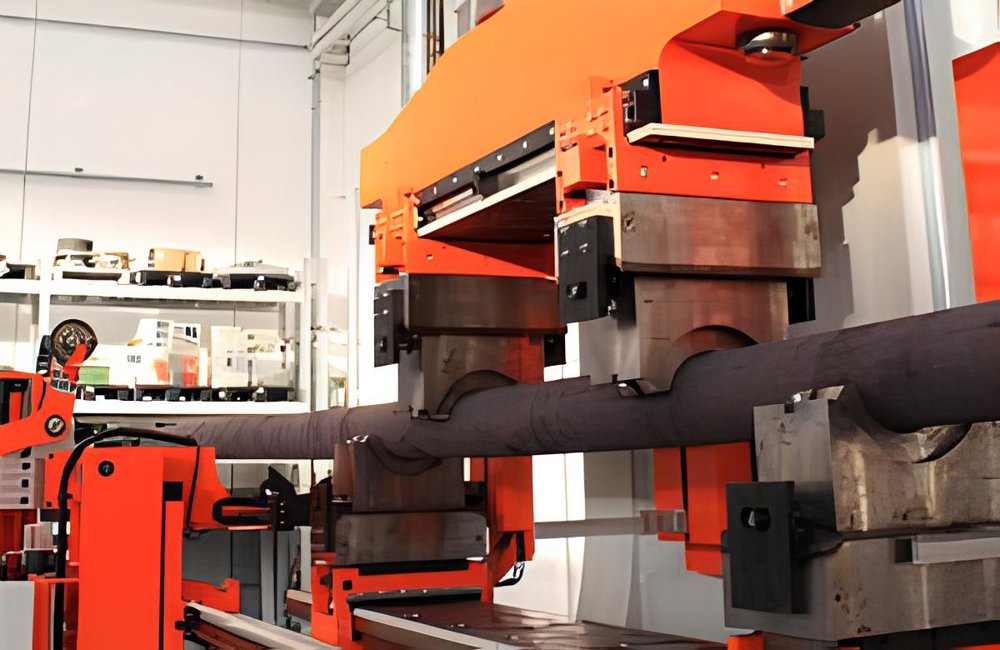
During processes such as rolling, forging, machining or heat treatments, metal components can undergo deformations that compromise the dimensional tolerances required by the design.
To eliminate these imperfections, straightening machines intervene: industrial systems designed to restore bars, shafts, tubes and profiles to their original geometry through the controlled application of force.
Thanks to technological evolution and automation, modern straightening machines allow high levels of precision, repeatability and productivity to be achieved, becoming a strategic stage within numerous production processes.
What straightening machines are
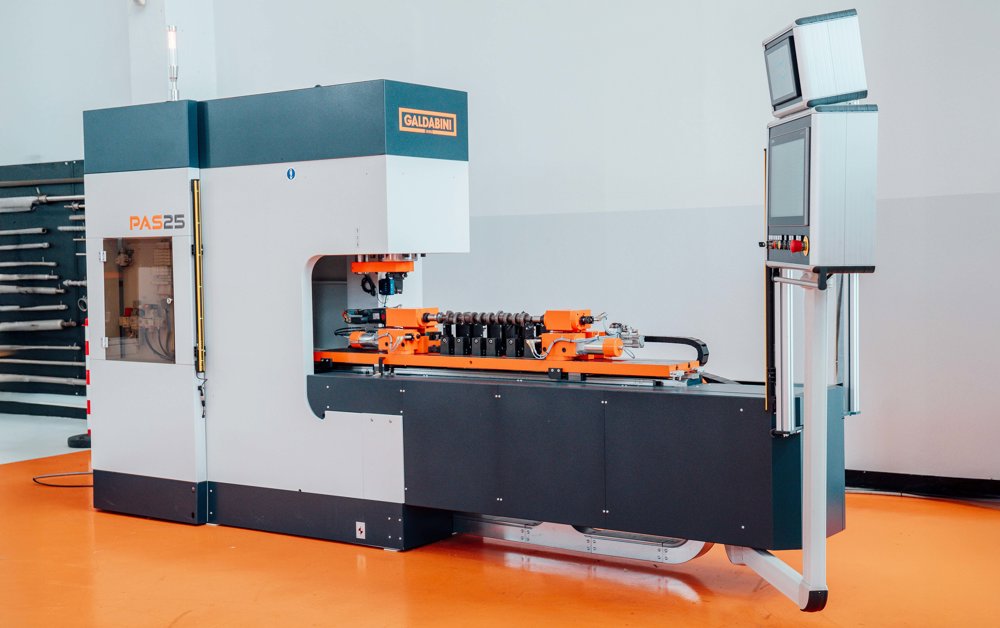
Straightening machines are industrial plants used to correct deformations and misalignments present in metal components.
Through advanced measurement and control systems, these machines identify the deformed areas of the part and apply a calibrated force that brings the component back within the dimensional tolerances required.
The objective is not simply to "straighten" a metal element, but to ensure:
- geometric accuracy;
- quality of the finished product;
- process repeatability;
- reduction of scrap;
- optimization of subsequent machining operations.
Straightening machines can operate manually, semi-automatically or fully automatically, depending on production needs and the level of integration required by the line.
How a straightening machine works
The operating principle is based on measuring the deformation and subsequently applying a controlled force at the critical points of the component.
The most advanced machines integrate:
- automatic measurement systems;
- process control software;
- real-time monitoring;
- recording of processing data;
- cycle self-correction systems.
The intervention takes place exclusively in the areas where deformation is detected, minimizing unnecessary stresses on the material and ensuring the highest possible precision.
This approach makes it possible to achieve consistent results even on complex components and materials with high mechanical strength.
Which components can be straightened
Straightening machines are applied to a wide range of metal components, including:
- drive shafts;
- half-shafts;
- gearbox shafts;
- rolled bars;
- forged bars;
- turned bars;
- metal tubes;
- racks;
- linear guides;
- metal profiles;
- precision mechanical components.
The versatility of modern straightening machines allows them to work on parts of different sizes, geometries and mechanical characteristics.
Applications of straightening machines in different industrial sectors
Automotive, transport and e-mobility
In the automotive sector, geometric accuracy is essential to ensure reliability, safety and performance.
Components such as drive shafts, half-shafts and gearbox shafts must meet extremely strict tolerances. Straightening machines make it possible to correct deformations generated during machining and heat treatments, ensuring component conformity before assembly.
Oil & Gas, steelworks and forgings
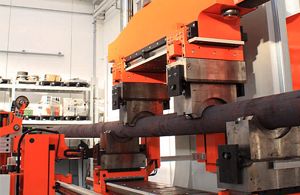
In the production of bars, tubes and forged components, rolling and heat treatment processes can generate significant deformations.
Straightening machines restore the correct geometry of the pieces, guaranteeing high dimensional standards, a fundamental requirement for high-criticality applications such as those in the energy and oil sectors.
Precision engineering
In precision engineering, even minimal geometric deviations can compromise the functioning of a component.
Straightening therefore represents an essential stage to achieve very tight tolerances and prepare parts for subsequent finishing or assembly operations.
Production of metal profiles
Linear guides, racks, structural profiles and elements intended for industrial automation require high levels of straightness along their entire length.
Straightening machines allow localized deformations to be eliminated and geometric uniformity to be maintained, improving the final quality of the product.
Advantages of straightening machines
The adoption of advanced straightening technology offers numerous advantages:
- greater dimensional accuracy;
- reduction of production scrap;
- improvement of product quality;
- increase in productivity;
- reduction of manual interventions;
- greater process repeatability;
- optimization of subsequent operations;
- control and traceability of production data.
Conclusions
Straightening machines represent an indispensable technology for all companies operating in metalworking that must guarantee high quality standards.
Thanks to the ability to correct deformations on bars, shafts, tubes and profiles with high precision, these systems help improve the quality of the finished product, increase production efficiency and reduce costs related to scrap and rework.
In an industrial context increasingly oriented towards automation and process control, modern straightening machines confirm themselves as a strategic tool to enhance competitiveness and production performance.